Brad Raison
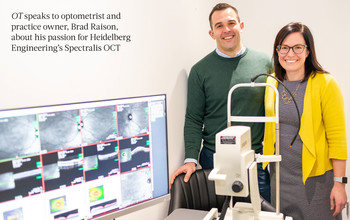
“The clarity and resolution is brilliant”
Why did you decide to investin an OCT?
Prior to opening our practice, Raison Opticians, in Helston, Cornwall, my business partner and wife, Libby Raison, and I locumed at a lovely practice in Penzance, Reynolds Opticians. The practice had an OCT and we quickly recognised how useful it was. Libby and I agreed that having an OCT would help us provide our patients with an extra layer of care.
Why did you choose the Spectralis?
Our decision-making process involved three steps: we talked to various people to find out what they used and why; we considered how each company supports the customer; and we looked at what each machine could do, including how repeatable the results were. What we realised was that Heidelberg Engineering’s Spectralis always seemed to be regarded as the ‘gold standard’ by the practitioners we spoke to. A clincher for us was a conversation that Libby, as secretary of our Local Optical Committee, had with a hospital macular consultant. When asked which OCT he would choose, he name-checked the Spectralis. You can’t get a better recommendation than that.
“The repeatability of the images we capture is so important, and with Spectralis the repeatability is incredible”
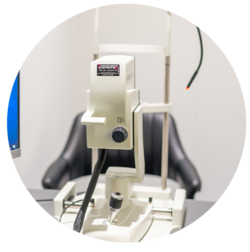
What are the standout features of your Spectralis?
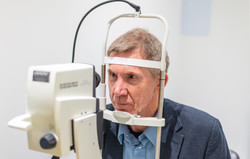
What stands out is the clarity of the images – I have been really surprised by how brilliant the resolution is. The repeatability of the images we capture is so important, and with Spectralis the repeatability is incredible. As a practitioner, you are always looking out for conditions such as glaucoma in every patient you see. With the Spectralis, I can measure the thickness of the retinal nerve fibre layer around the optic nerve head and in the follow-up scan I can repeat this to within one micron of where I was before. This means that the thickness values I am capturing are extremely close, and a subtle difference can be viewed as a reliable result. If your device doesn’t have good repeatability and you are measuring within 20–30 microns of the last position, your tolerance levels are going to be worse. The qualities of the Spectralis absolutely help when providing good patient care. We have a large proportion of elderly patients who find glare difficult; fundus photography and Volk examinations are really uncomfortable for them. However, they have very little issue with OCT and infrared fundus imaging, despite the extra chair time, as there is no bright flash and no need for pupil dilation. Even if you are doing a macular volume scan that takes about 30 seconds or so, they remain comfortable for the duration and can sit there happily for two or more scans. The modular functionality of Spectralis has also been helpful to us as a business, giving us the ability to bolt on new technology, such as glaucoma monitoring or OCT- Angiography. Being able to do this without having to buy an entirely new scanner is a nice position to be in. We don’t have to learn how to use a new tool or worry about transferring databases and losing full comparison data.
“I can measure the thickness of the retinal nerve fibre layer...and repeat this to within one micron of where I was before”
How does an OCT enhance patient care?
An example I give is my very first patient in our Helston practice. He came in with symptoms of distortion and reduced vision. Using the Spectrialis, I discovered that he had a full-thickness macular hole. I was able to email the scan to the consultant, which is a far more streamlined process than sending the patient to eye casualty to hang around and wait to be seen.
WHY BRAD LOVES HIS OCT...
“As an optometrist in community practice, every scan provides an extra level of reassurance that only OCT can give. By looking at a fundus photograph I may not notice a significant difference, but I know if the patient’s eye is in good condition with an OCT scan. And, having the same machine that NASA put on the International Space Station is a very cool feeling.”
Do you charge patients for OCT scans?
We charge £25 to have an OCT scan. The decision was based on conversations with colleagues and peers, checking other websites and thinking about the region we operate in. We do not see OCT as a major revenue stream. Our intention was to set the fee to cover the cost of the machine. This means that we can perform the scans on as many people as we can.
We have found that £25 does not seem to worry most of our patients. I would estimate 60–70% of our patients opt to have a scan. In our first six months we had a slow start, but to date we have carried out over 900 scans.
We offer an ‘Eyeplan’ – like a dental plan – which includes OCT at no extra cost. That’s been working very well for the practice. We like to give the patients choice.
How do you educate yourselves and your team when interpreting the images captured by your OCT?
Crucially, once we had ordered our Spectralis, Heidelberg Engineering provided support straightaway, including text books and online facilities. We had a one-to-one session with Heidelberg Engineering’s director of clinical affairs, Chris Mody; I think he is the Jedi Master of OCT. What he does not know about the back of the eye does not seem worth knowing. The educational support from Heidelberg Engineering is also ongoing. Its online academy is useful for learning tools, as well as clinical posters. The company also provides information that we can share with our patients.
Brad Raison, Optometrist and Practice Owner
Raison Opticians
SPECTRALIS Owner since 2018
Advertorial written and published by Optometry Today magazine.